

































-
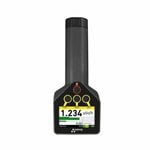
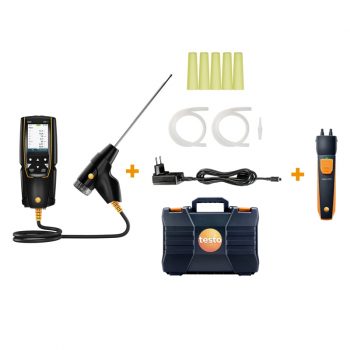
Printer Kit - including analyser with probe, testo Bluetooth printer, case, and power supply.
-
User-Friendly Interface - Intuitive colour display with clear menu navigation for simple operation.
-
Smart Connectivity - Bluetooth connection with testo Smart App for additional functionality and instant reporting.
-
Durable and Practical Design - with integrated kink-resistant hose & 30-second auto-zeroing.
 Datenblatt Datenblatt
|
|
Bedienungsanleitung
|
- testo 300 flue gas analyzer with O2and CO sensor up to 4,000 ppm (0633 3002 78)
- USB mains unit, including cable (0554 1105)
- Compact basic flue gas probe, 180 mm; Ø 6 mm; Tmax. 500°C; 1.5 m hose; including cone for fixing (0600 9740)
- 1 x testo 510i Smart probe manometer (0560 1510)
- 2 x testo 115i Smart probe pipe clamp thermometers (0560 2115 02)
- testo Bluetooth® connector (0554 3004)
- soft-case style Instrument bag (0516 3001)
| Datasheet |
| User Manual |
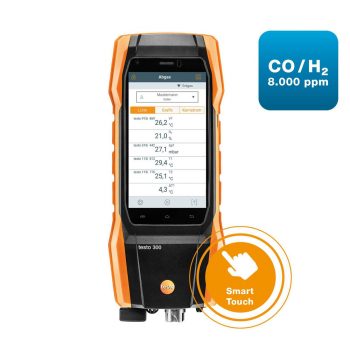
- Intuitive measuring menus with responsive smart-touch display
- Incl. O2 and H2-compensated CO sensor up to 30,000 ppm (NO sensor can be retrofitted); integrated fine draft pressure measurement
- Integrated fine draft pressure measurement
- On-site documentation and sending reports by e-mail
- Versatile probes and fast probe changes by the user
- Magnetic mount for fixing the device in place
- Efficient, wireless parallel measurement with up to four testo Smart Probes at the same time
- Practical second-screen function and easy data integration into user-specific software
| Datasheet |
| User Manual |
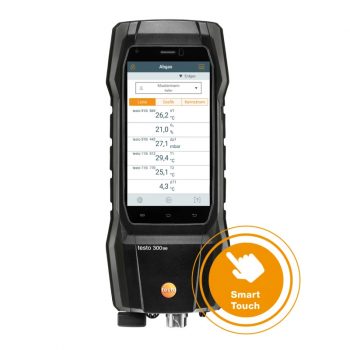
- Intuitive measuring menus with a responsive smart-touch display
- Incl. O2 and H2-compensated CO sensor up to 30,000 ppm, NO sensor up to 3,000 ppm; integrated fine draft pressure measurement
- Integrated fine draft pressure measurement
- On-site documentation and report dispatch by e-mail
- Versatile probes and fast probe changes by the user
- Magnetic mounting for fixing the device in place
- Efficient, wireless parallel measurement with up to four testo Smart Probes simultaneously
- Practical second screen function and easy data integration into user-specific software
| Datasheet |
| User Manual |
- Intuitive measuring menus with a responsive smart-touch display
- Incl. O2 and H2-compensated CO sensor up to 30,000 ppm, NO can be retrofitted
- Integrated fine draft pressure measurement
- On-site documentation and report dispatch by e-mail
- Versatile probes and fast probe changes by the user
- Magnetic mounting for fixing the device in place
- Efficient, wireless parallel measurement with up to four testo Smart Probes simultaneously
- Practical second screen function and easy data integration into user-specific software
| Datasheet |
| User Manual |
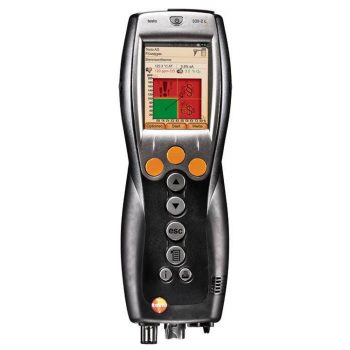
- Independently tested to EN50379. Meets the requirements of BS7967 and Gas Safe TB143
- Longlife sensors lasting up to 6 years
- Dilution to 30,000ppm CO
- Optional NO sensor upgrade
| Datasheet |
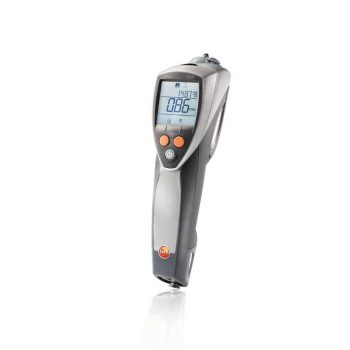
- Handy and robust Easily possible to carry to the desired application site
- Determination of soot concentration (mg/m3) as well as Filter Smoke Number (FSN) or Bosch number
- Easy one-handed operation
- Direct analysis and display of measurement values, optional on-site printout of data with Testo fast printer
 Datasheet Datasheet
|
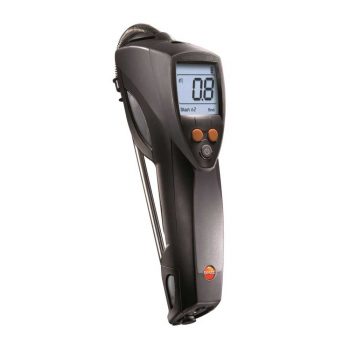
teste 308 smoke tester, incl. rech. battery, mains unit and calibration protocol. Measuring range - 0 to 6 RZ Accuracy - 0.2 RZ Resolution - 0.1 RZ
|
Datasheet
|
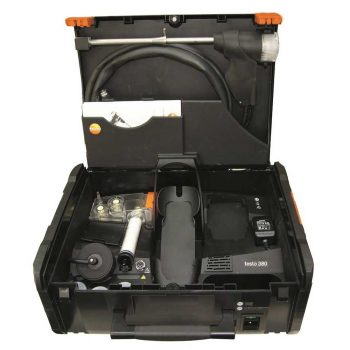
- In combination with testo 330-2 LL, the innovative complete solution for solid fuels, oil and gas systems.
- Unrestricted TÜV test for the limit value levels 1/2 and according to VDI 4206 Sheet 2
- Parallel measurement of fine particles, O2 und CO
- Graphic presentation of all measurement values in real time
- Especially economic in operation and maintenance
- Effortless handling and easy transport
- High-tech in a case: Measurement of all relevant values with only one probe
| Datasheet |
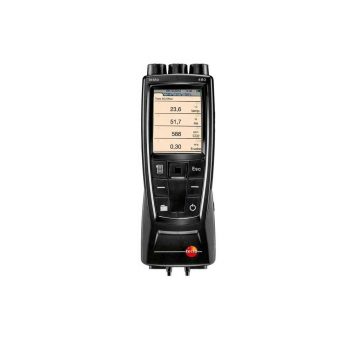
Air flow measurements in ducts, temperature measurements in laboratories, humidity measurements in production, pressure difference measurements in clean rooms. The testo 480 digital temperature, humidity and air flow meter comes with a wide range of optional sensors that allow you to measure, analyse and log these and a variety of other parameters with only one device
| Datasheet |

Flue Gas Analyzers
Flue gas analyzers are specialized instruments for analyzing the emissions of technical and industrial combustion systems. They capture pollutant concentrations (e.g. CO, CO₂, NOx, SO₂), temperature, pressure and flue-gas losses to monitor emissions and improve combustion efficiency. These devices may be portable or permanently installed and support compliance with legal regulations as well as operational optimization.
FAQ
Which measurement parameters are typical for flue-gas analyzers?
Common parameters include oxygen (O₂), carbon dioxide (CO₂), carbon monoxide (CO), nitrogen oxides (NOx), sulfur dioxide (SO₂), flue-gas temperature and flue-gas loss – the portion of energy lost through the exhaust. :contentReference[oaicite:9]{index=9}
Where are flue-gas analyzers typically used?
They are used in boiler and burner testing, industrial combustion systems, engine test benches, power plants and emissions monitoring to protect the environment and ensure safety. :contentReference[oaicite:10]{index=10}
What sensor and measurement technologies are used?
Common technologies include electrochemical sensors, infrared sensors, mass-spectrometry, sample-gas filters and temperature/pressure probes. Clean sampling and proper filtering are crucial for accurate results. :contentReference[oaicite:11]{index=11}
What is flue-gas loss and why is it measured?
Flue-gas loss quantifies the portion of energy lost through the exhaust stream instead of being converted to useful heat. High losses indicate inefficient combustion and may require adjustments or maintenance. :contentReference[oaicite:12]{index=12}
How often should analyses be carried out?
The frequency of measurements depends on device type, fuel, system and regulations. For example, the German 1st BImSchV mandates regular inspections of combustion systems. :contentReference[oaicite:13]{index=13}
How do environmental conditions affect measurement accuracy?
Temperature and humidity variations can affect sensor response, cause condensation or alter sample-gas composition, thus impairing measurement accuracy. Proper ambient conditions or gas conditioning may be necessary. :contentReference[oaicite:14]{index=14}
Why is sample-gas handling important?
Accurate results require high-quality sampling: removal of particulates or condensate, correct probe positioning and integrity of the sample path. Poor sampling can lead to misleading efficiency or emission assessments. :contentReference[oaicite:15]{index=15}
What interfaces and data options do modern analyzers offer?
Modern devices provide interfaces such as 4–20 mA, Modbus, USB or WiFi, include data logging, trend analysis and automatic report generation to document measurements and emission values.