













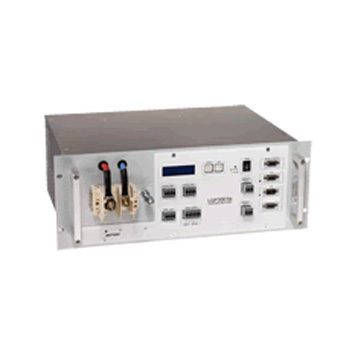
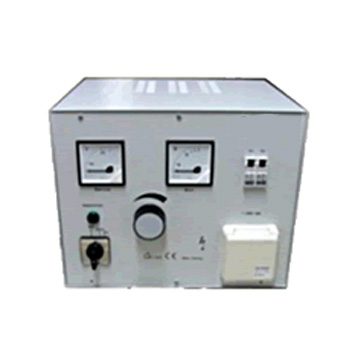































Isolation Transformers and Variable Autotransformers
Isolation transformers and variable autotransformers provide galvanic isolation and adjustable voltage supply. Isolation transformers electrically separate the primary and secondary sides to improve safety and protection during measurements, testing or operation of equipment without direct mains earth reference. Variable autotransformers allow stepless or stepwise adjustment of the output voltage — ideal for adapting voltage levels in test benches, devices or machines requiring flexible supply.
Questions & Answers on Isolation and Variable Autotransformers
What is the purpose of an isolation transformer?
An isolation transformer provides a galvanically isolated, floating secondary side. This enhances safety, particularly for measurements, tests, or maintenance. It prevents interference currents, ground loops and mains-referenced potential — useful when devices require a defined isolation reference.
When is the use of a variable autotransformer appropriate?
A variable autotransformer is useful when devices or test setups need to operate at varying voltages. It allows the output voltage to be adjusted continuously (rotary autotransformer) or in steps (tap autotransformer). This makes it possible, e.g., to test a lamp, motor or equipment under different voltage levels.
How do isolation and autotransformers differ technically?
An isolation transformer uses separate windings for primary and secondary side, without common ground. A variable autotransformer uses a tapped winding or autotransformer design — here there is no full winding isolation, but voltage is regulated via a tapped winding. Thus isolation and flexibility of voltage adjustment differ depending on type.
What voltage ranges are typical?
Isolation transformers usually provide secondary voltages equal to mains voltage (e.g. 230 V), sometimes also 115 V or 400 V depending on design. Variable autotransformers, on the other hand, often offer a variable output range — e.g. 0 … 230 V or 0 … 400 V depending on the model. This allows flexible operation of loads at lower or higher voltages.
How does galvanic isolation affect safety and fault currents?
Galvanic isolation prevents a direct connection between mains and output. This protects personnel and measuring instruments from earth potential, reduces risk of mains return currents, and avoids ground loops. In case of fault currents or insulation faults, the secondary remains isolated — this minimizes touching hazards and ground-loop currents and improves safety in labs and test environments.
What must be considered when sizing transformers?
Important are the rated power in VA / current, the voltage ranges (primary and secondary), insulation class, short-circuit current capability, load capacity under varying voltage and during long runtimes. For autotransformers, the range of adjustable voltage and maximum current for the intended load must be sufficient.
Is the output voltage stable under load with autotransformers?
Depending on the type, the output voltage may drop slightly under load, especially if the tap or setting is not sufficiently rated. High-quality devices are designed so that voltage and current remain stable as long as the load is within their rated capacity.
Which mechanical designs and connection types are common?
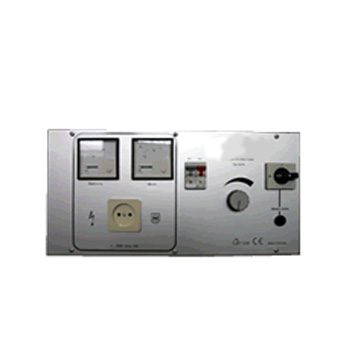
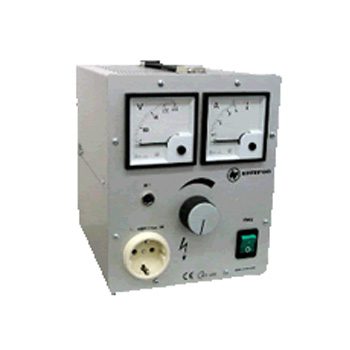
Common designs include enclosed metal housings as bench- or wall-mounted units with primary and secondary connection terminals or safety-plug connectors. Tapped autotransformers may offer selectable taps or rotary knobs for voltage selection. Isolation transformers are often compact, while variable autotransformers may have larger windings to handle variable voltages and higher power.
How does a variable autotransformer affect electromagnetic compatibility and shielding?
Thanks to their metal housings and windings, transformers are generally well shielded against electromagnetic interference. However, at high power ratings magnetic fields may arise — therefore a distance to sensitive electronics or additional shielding may be advisable. Isolation of windings can also reduce reference-ground issues in sensitive measurement applications.
Can isolation and variable autotransformers be combined?
Yes — combining an isolation transformer with a connected autotransformer can provide both galvanic isolation and adjustable output voltage. This can be useful in test benches where adjustable voltages and safe isolation are required. However, proper isolation coordination and correct wiring are critical and must be ensured.
For which application areas are these transformers especially suitable?
They are particularly suitable for laboratories, workshops, test benches, training facilities, experimental setups, machines requiring variable voltage, device development, repair and maintenance, and for environments where safety and galvanic isolation are important — e.g. measurement instruments, insulation testing or work on mains-connected equipment without earth reference.
What advantages do variable autotransformers offer compared to simple voltage regulators?
Variable autotransformers offer a wide voltage range and high current capability without complex electronics. They are robust, durable and tolerant against overload and electromagnetic disturbances. Compared to electronic voltage regulators they provide simpler maintenance, less vulnerability and often galvanic separation advantages.
How does thermal load affect transformers?
Under high load over extended periods, windings and housing heat up. Quality devices feature sufficiently sized windings, cooling surfaces or ventilation as well as thermal protection. Continuous overload may lead otherwise to overheating, voltage drop, insulation damage or premature failure — proper sizing is therefore critical.
Do transformers need regular maintenance?
Transformers are generally low-maintenance. Nevertheless, under heavy use a regular visual inspection for damage, corrosion or dirt is recommended, terminals should be checked and fastenings possibly retightened. For older devices an insulation resistance check may be advisable to detect ageing or moisture ingress early.