









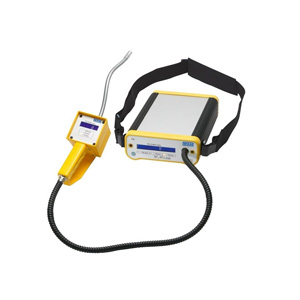
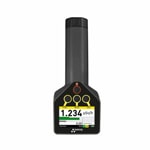
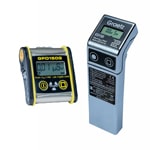
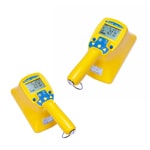

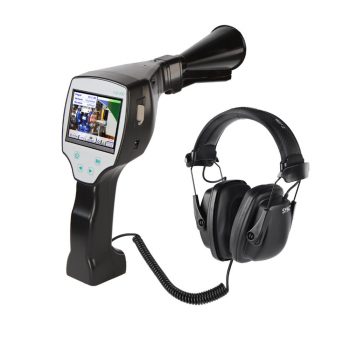


























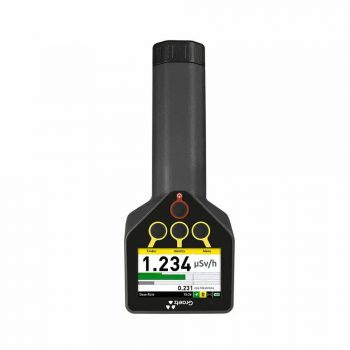
- 2″ x 1″ BGO (Bi4Ge3O12) detector with superior efficiency
- Improved overall robustness with non-hygroscopic BGO detector
- Novel sourceless gain stabilization (Pat. US 9,864,076).
- High dose rate capability and neutron detection with one detector
- Nuclide identification at up to 1 million Ip/s
- Directional radiation detection
- Easy system integration through HTTP REST interface & universal API
- N42.42 data format for simple remote data transmission
- Remote control and configuration via web interface or app
- Nuclide library (> 70 nuclides) exceeds IEC-62755 and ANSI-42.34 requirements
 Datasheet Datasheet |
| Brochure |

Radionuclide Identifier (RID) / Radionuclide Identification Devices
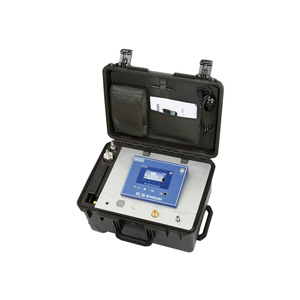
A Radionuclide Identifier (RID) is a portable spectrometer used to detect radioactive sources, measure radiation, and identify the radionuclides present in a source. It enables localization, classification and quantification of radioactive materials — be they natural or artificial — making it a key instrument for security, environmental monitoring and radiation protection.
Questions & Answers on Radionuclide Identifiers
What is a Radionuclide Identifier (RID)?
An RID is a compact, portable gamma spectrometer that measures radiation and, based on the energy spectrum, identifies the radionuclides contained in a source. Unlike simple radiation detectors (e.g. Geiger counters), it does not only indicate activity or dose, but determines which isotopes are present. :contentReference[oaicite:11]{index=11}
What are typical applications for RIDs?
Typical applications include environmental monitoring, inspection of radioactive materials, security and emergency response, checking industrial or medical sources, and nuclear security — wherever unknown or potentially hazardous radioactive sources must be identified. :contentReference[oaicite:12]{index=12}
How does a radionuclide identification work?
The device measures the energy of incoming gamma or other radiation and creates an energy spectrum. Based on known energy lines of radionuclides, the spectrometer determines which nuclide is present — even in mixed or shielded sources. :contentReference[oaicite:13]{index=13}
What types of radiation can a modern RID detect?
Modern RID systems often can detect gamma and X-rays — and depending on the detector also neutrons or cosmic radiation. Thus both natural and artificial sources can be analyzed. :contentReference[oaicite:14]{index=14}
Which detector technologies are used?
Scintillation crystals are commonly used as detectors. For example, a BGO (bismuth germanate) detector is used for high robustness, non-hygroscopicity and efficient detection. Other detector types like NaI, LaBr₃ or similar crystals are also used depending on required sensitivity and energy resolution. :contentReference[oaicite:15]{index=15}
What standards or specifications should RIDs meet?
RIDs should comply with standards such as ANSI N42.34 (or relevant national/international equivalents). These define requirements for energy range, spectrum identification, stability, ruggedness, temperature/environmental resilience and waterproofing for mobile use. :contentReference[oaicite:17]{index=17}
What are the requirements for stability and measurement quality?
The instrument should maintain stable calibration even under varying temperature or environmental conditions. Modern devices often use quellenlose Verstärkungsstabilisierung, which avoids Drift and improves safety compared to systems with eingebauten radioaktiven Quellen. :contentReference[oaicite:18]{index=18}
How fast can a radionuclide be identified?
Depending on the activity of the source and its shielding, RIDs can work very quickly. Identification times in the order of seconds are possible, even for relatively weak radiation sources. :contentReference[oaicite:19]{index=19}
What data output and interfaces do modern RIDs provide?
Modern devices often offer digital interfaces (e.g. HTTP-REST, universal APIs), standardized data formats such as IEEE‑N42.42, and data storage for spectra, dose rates and measurement logs — enabling integration into monitoring systems and remote analysis. :contentReference[oaicite:21]{index=21}
Who should operate an RID?
Operation should be carried out by trained personnel familiar with radiation protection and radioactive sources. Interpreting measurement results requires specialist knowledge. Also, safety and protection measures must comply with applicable regulations.
What documentation is recommended after a measurement?
After a measurement, documentation should include the measured spectrum, identified nuclide(s), dose rate, date, location and operator. In critical cases also shielding and environmental conditions, plus full measurement logs and stored spectra — to ensure traceability and auditability.