


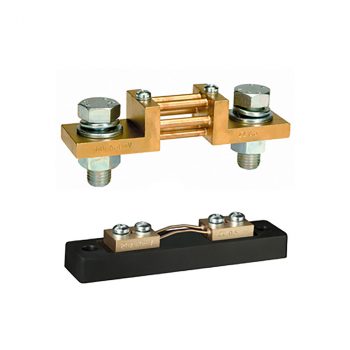
- It gives a mV signal directly proportional to the measured current
- Primary current 1...6000A
- Voltage drop 60 - 100 - 150 mV
- Accuracy cl. 0.5
- Dimensions according to DIN43703
 Datasheet Datasheet |

Shunt Resistors for Panel-Metering and Switchgear Applications
Shunt resistors are low-ohmic precision resistors used to make high currents measurable. When current flows through the shunt, it produces a small, accurately defined voltage drop. This voltage is measured and used to calculate the current via Ohm’s law. Shunts allow high-current circuits to be monitored safely without routing the full current through the measuring device.
Questions & Answers
What is a shunt resistor?
A shunt resistor is a very low-resistance, high-accuracy resistor installed in series with the load. The voltage drop across it is proportional to the current, allowing indirect and safe measurement of high currents.
Why are shunts used?
Many measuring devices cannot handle high currents directly. A shunt allows the current to remain in the power circuit while only the small proportional voltage is sensed by the meter, protecting the instrument and extending its measurement range.
How does current measurement with a shunt work?
According to Ohm’s law, the voltage drop (U) across a known resistance (R) is measured and the current (I) is calculated by I = U / R. Because the resistance is extremely low but precisely defined, the resulting current measurement is accurate.
What voltage drop is typical for a shunt?
Typical rated voltage drops are 60 mV, 75 mV, 100 mV or 150 mV at nominal current. The value is kept low to minimize losses while still providing a measurable signal.
What current ranges can shunts measure?
Shunts are available for a wide range of currents — from small to several thousand amperes — making them suitable for industrial systems, battery installations, power distribution panels and energy systems.
What should be considered when selecting a shunt?
The rated current, rated voltage drop, resistance value and thermal load capacity must match the application. The measurement device must be compatible with low-level voltage signals, and installation should account for cable resistance and heat dissipation.
Can shunts be used for both AC and DC?
Yes. Shunts work very well for DC. They can also be used for AC, provided the measuring device supports the frequency and type of signal being measured.
Which measurement devices can be used with shunts?
Any device that measures small voltages — such as voltmeters, panel meters, analog inputs of controllers, data loggers or signal converters — can be used with a shunt resistor.
What are the advantages of using shunts in control cabinets?
They enable precise high-current measurements, reduce the need for bulky current transformers, simplify wiring, and allow straightforward integration or retrofit into existing installations.
Are there disadvantages when using shunts?
Potential drawbacks include heat generation at high currents, lack of galvanic isolation, and the inherently small voltage drop that must be measured accurately. Incorrect dimensioning can lead to reduced accuracy or overheating.