





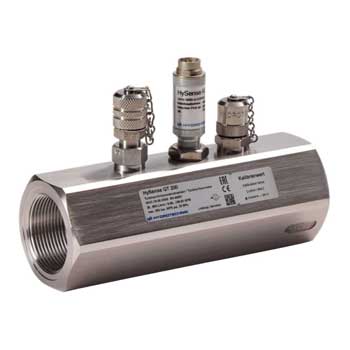












































- Suitable for liquid, gas and steam flow measurement
- Accuracy ≤ ±0.5 % of actual flow rate
- Repeatability of measurement 0.1 %
- Lowest pressure loss in the family of primary flow elements
- Calibration may be performed if required
 Datasheet Datasheet |
| User Manual |

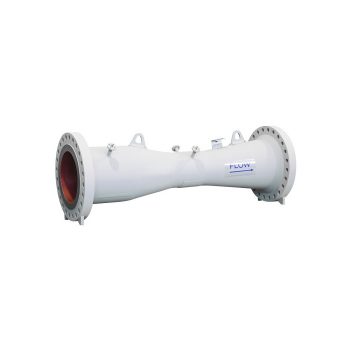
H² Venturi Tubes for Hydrogen Flow Measurement
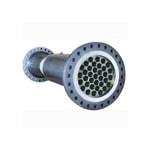
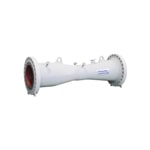
An H² venturi tube is a primary flow element based on the Venturi effect, specially adapted for measuring hydrogen gas or hydrogen mixtures. By constricting the pipe cross-section, a differential pressure is generated that can be evaluated by a differential pressure transmitter. This allows reliable and repeatable measurement of mass or volumetric flow — even at high pressures and gas velocities typical for hydrogen systems. Venturi tubes are robust, low-maintenance and well suited for industrial applications with varying flow rates and fluctuating process conditions.
FAQ / Frequently Asked Questions
How does a venturi tube work in principle?
A venturi tube features a narrowed cross-section ("throat"). When hydrogen flows through this tube, the fluid velocity increases in the throat and the static pressure decreases. The pressure difference between upstream and the throat allows calculating the flow rate, given known fluid density and geometry. :contentReference[oaicite:9]{index=9}
Why is the Venturi principle suitable for gases and hydrogen?
The Venturi principle applies to both liquids and gases. For gases like hydrogen, the flow velocity and density changes lead to a measurable pressure drop — by evaluating the differential pressure and compensating for density and pressure conditions, volumetric or mass flow can be determined. :contentReference[oaicite:10]{index=10}
Which venturi tube designs are available?
Venturi tubes are commonly available as welded or flanged units. The internal diameter, manufacturing method (e.g. machined or fabricated inlet cone) and the beta-ratio (ratio of inlet to throat area) can be adapted to suit the medium, pressure, temperature and flow range. :contentReference[oaicite:11]{index=11}
What measurement accuracy can be expected from venturi flowmeters?
Venturi flowmeters are regarded as precise and repeatable. Depending on the design and calibration, measurement uncertainty typically lies in the order of about ± 0.5 % up to 2–3 % of flow rate. :contentReference[oaicite:12]{index=12}
What are the advantages and limitations of venturi tubes?
Advantages: no moving parts, low wear, high long-term stability, robust construction, low maintenance effort and small permanent pressure loss if properly designed. Limitations: correct installation with sufficient straight inlet/outlet runs is required; for compressible gases and fluctuating conditions, density and pressure compensation must be implemented to ensure accuracy. :contentReference[oaicite:13]{index=13}
In which applications are H² venturi tubes suitable?
H² venturi tubes are suitable for any hydrogen pipeline flow measurement: production, storage, distribution, reforming, supply lines, industrial processes. They are especially advantageous where robustness, stability and low maintenance are required. :contentReference[oaicite:14]{index=14}
Which materials are recommended for hydrogen venturi tubes?
Wetted parts should be made from hydrogen-compatible, diffusion- and embrittlement-resistant materials — typically high-alloy stainless steels or nickel-based alloys. Material selection depends on operating pressure, temperature and hydrogen purity. If necessary, special alloys or coatings may be used to ensure longevity.
How should a venturi tube be properly installed?
The piping must provide adequate straight runs upstream and downstream to ensure stable flow conditions. Pressure tapping points must be properly oriented, free of deposits or disturbances. Installation must be stress-free to avoid mechanical strain, prevent leaks and minimise measurement errors. :contentReference[oaicite:15]{index=15}
How do pressure and temperature affect the measurement?
Because hydrogen is compressible and density dependent on pressure and temperature, flow calculations must account for these effects. Density, pressure and temperature compensation is essential to obtain accurate volumetric or mass flow values.
How maintenance-intensive are venturi flowmeters?
Venturi tubes generally require little maintenance, as they have no moving parts and operate by static pressure measurement. However, regular inspection of pressure taps, seals and internal surfaces is advisable to check for deposits, corrosion or wear, ensuring long-term measurement reliability.
When are venturi tubes preferred over other measurement technologies?
Venturi tubes are preferred when a robust, stable and low-maintenance solution for flow measurement is needed — particularly when high flow rates, long-term operation, and minimal operational costs are desired. They are ideal in industrial hydrogen pipelines. In cases where frequent flow changes, very small flow rates or extreme process dynamics occur, alternative technologies (e.g. mass flow meters) may be more suitable.