






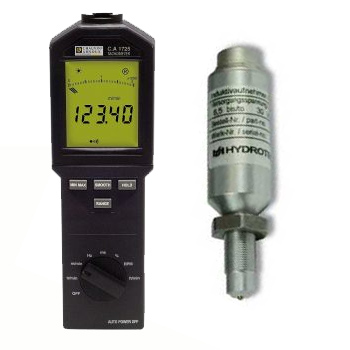



























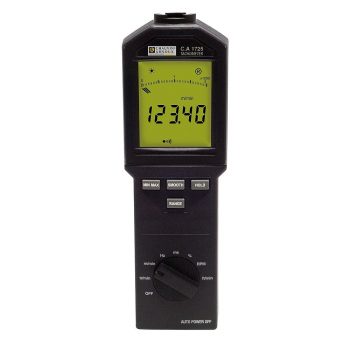
Specially designed for industrial applications, the CA 25 tachometer measures, at a distance or by contact, any rotation speed from 60 to 100 000 tr/min.
 Datasheet Datasheet |
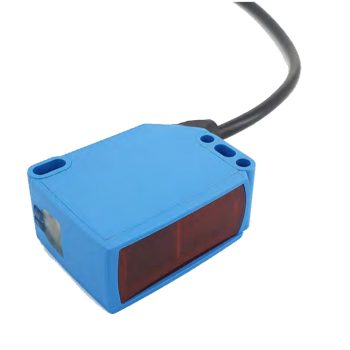
- Sensor principle Autocollimation
- Light source Power LED with visible red light
- Response time 500 µs
- Range 0 … 500 mm (standard reflectors)
- Pulsing frequency 500 Hz / 30000 min-1
- Signal repetition rate Max. 500 Hz
- Electrical connector M16 x 0.75, 5-pin
- Body material Glass fiber reinforced
- Ambient temperature -40 … 60 °C
 Datasheet Datasheet |
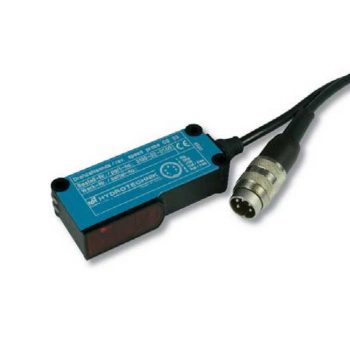
HySense sensors cover all important physical measurands of importance for diagnosis and condition monitoring of fluid-technical systems.
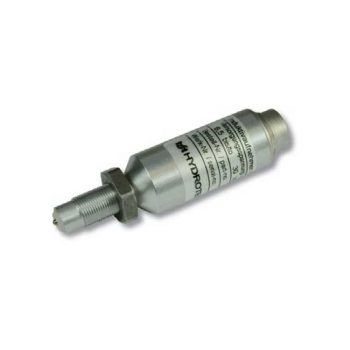
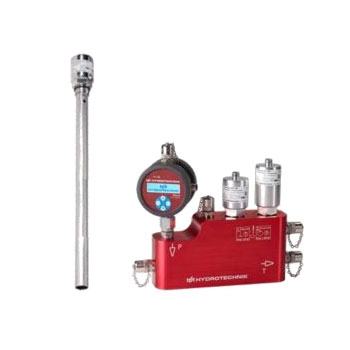
The rotational speed sensor HySense® RS 210 works inductively and is able to detect the cogs of a cogwheel. After entering the number of cogs into the measuring instrument, a reliable rotational speed detection is assured. The sensor head must be mounted between 1.5 and 2 mm away from the cog wheel.
|
Datasheet
|
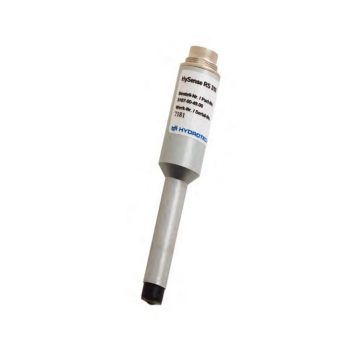
- Sensor principle GMR effect
- Frequency range 0.5 … 1800 Hz
- Measuring accuracy ±1 pulse
- Electrical connector M16 x 0.75, 5-pin / M16 x 0.75, 6-pin
- Body material Aluminum
- Ambient temperature -20 … 85 °C
- IP degree of protection IP65 (DIN EN 60529)
- Weight 60 g
| Datasheet |

- Frequency range ~ 1...10000Hz
- Automatic sensor detection and linearization ISDS
- Robust design
- IP degree of pro- tection of enclosure: IP67
- housing: Aluminium, anodised
- supply 8 .... 30 VDC
- current 3 mA
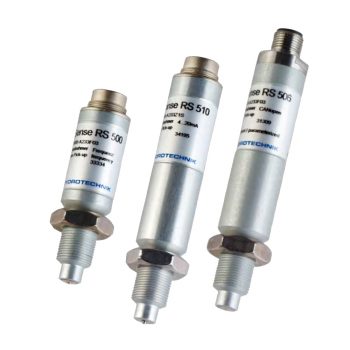
Sensor principle Electromagnetic induction
Measuring range 1 … 10000 Hz (RS 500 & RS 506)
1 … 5000 Hz (RS 510)
Measuring accuracy ±1 pulse (RS 500)
±0.1% of full scale (RS 506 & RS 510)
Electrical connector M16 x 0.75, 6-pin / M12, 4-pin*
Mechanical connection M14 x 1
Body material Aluminum
Ambient temperature -25 … 85 °C (RS 500 & RS 510)
-20 … 70 °C (RS 506)
IP degree of protection IP67 (DIN EN 60529)
Catalog Excerpt
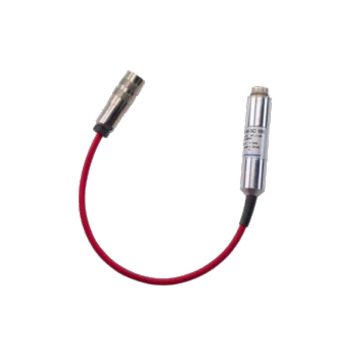
- Measured variable Frequency (optionally two frequencies)
- Measuring range 0 ... 5000 Hz
- Output signal 4 ... 20 mA, ISDS (optional switching output Ub+)
- Measuring accuracy ±0.1% of full scale
- Electrical connector 1 M16 x 0.75, 6-pin
- Electrical connector 2 M16 x 0.75, 6-pin
- Body material Aluminum
- Ambient temperature -25 ... 85 °C
- IP degree of protection IP67 (DIN EN 61076-2-106)
- Weight 75 g
| Datasheet |

-
Optical rpm measurements
-
LED measuring spot marking
-
Easy-to-read, backlit display for use in all lighting conditions
-
Long list of accessories including reflective markers, protective cap and belt bag
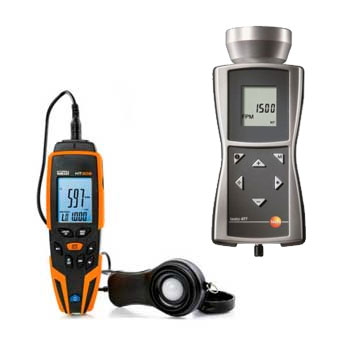
For carrying out non-contact rpm measurements: the testo 460 tachometer with self-adhesive reflective markers, LED measurement spot marking and a long list of high-quality accessories.
| Datasheet |
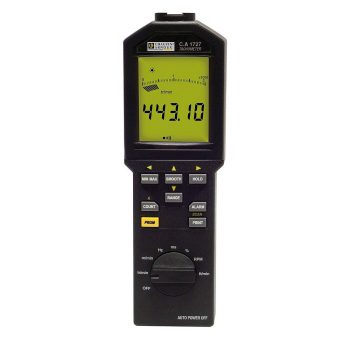
Specially designed for industrial applications, the CA 27 tachometer measures, at a distance or by contact, any rotation speed from 60 to 100 000 tr/min.
|
Datasheet
|
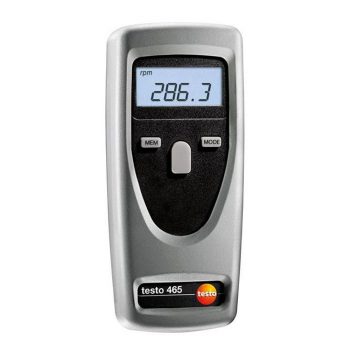
- Extremely easy one-handed operation
- Saves mean/max./min. values, as well as the last measuring value
- Robust tachometer – thanks in particular to the protective case (SoftCase) supplied
- Includes reflective markers
You can use the testo 465 tachometer for quick and easy rpm measurement on rotating parts such as fans and shafts.
|
Datasheet
|
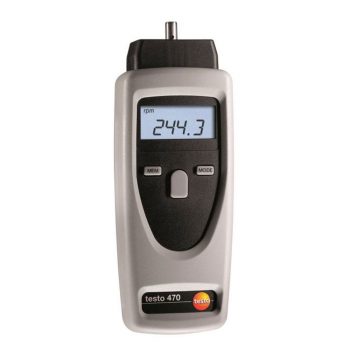
- Simple one-hand operation
- Measurement of rpm, speeds and lengths
- Storage of mean, max. and min. values as well as the last reading
- Includes accessories such as reflective markers, protective case and transport case
One tachometer, multiple measurements: The testo 470 tachometer carries out rpm measurements on motors, shafts, fans, etc., but that’s not all. With this handy instrument, you can also determine speeds and lengths (e.g. of conveyor belts and rotors).
|
Datasheet
|
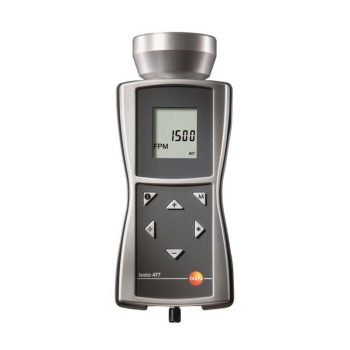
- Extremely high measurement range: up to 300 000 flashes per minute (fpm)
- Very high illumination: up to 4800 Lux
- Long operating times: battery power for up to 5 h
- Trigger input and output for connectivity to external systems and control via external sensor
Inspections and quality control of machines and systems, rotational speed measurements of hard-to-reach, small and fast-moving objects. And all while the machines are still running. No problem. No problem at all. With the testo 477 LED stroboscope.
|
Datasheet
|

Speed Sensors & Tachometers – Precision Measurement of Rotational Speed
Speed sensors and tachometers are instruments that measure the rotational speed (rpm) of shafts, wheels or machines. These devices are used for monitoring, control and safety in many industrial applications. They support processes such as drive monitoring, machine health, detection of anomalies and integration into automation systems. :contentReference[oaicite:0]{index=0}
The product category offers a wide range of technologies — magnetic, inductive, optical, eddy-current, Hall-effect sensors — and devices capable of very high speeds (e.g., up to 100 000 min⁻¹) with features such as event counting, frequency or period measurement, USB interfacing and advanced programming. :contentReference[oaicite:1]{index=1}
FAQ about Speed Sensors & Tachometers
Answers to common questions about choice, operation, installation, and applications.
What does a speed sensor measure?
A speed sensor detects the rotational speed of an object such as a shaft, gear or wheel and converts it into an electrical signal (e.g., Hz, pulses per second, or rpm). :contentReference[oaicite:2]{index=2}
Which measurement principles are used for speed sensors?
Common methods include: – Inductive sensors (detect metal teeth or ferromagnetic structures) :contentReference[oaicite:3]{index=3} – Hall-effect sensors (detect magnetic field changes) :contentReference[oaicite:4]{index=4} – Optical or laser sensors (detect marks, holes or reflections) :contentReference[oaicite:5]{index=5} – Eddy-current sensors for non-ferromagnetic targets :contentReference[oaicite:6]{index=6}
What are typical applications for speed sensors?
They are used in drive systems, motors, turbines, gearboxes, conveyors, wind turbines, automotive systems, and general machine monitoring for speed control, over-speed protection or condition monitoring. :contentReference[oaicite:7]{index=7}
What factors should I consider when selecting a speed sensor?
Important considerations include: maximum rotational speed, shaft diameter or target geometry, type of output signal (pulse, analog, frequency), environmental conditions (temperature, vibration, dust, moisture), mounting distance and target material. Also decide whether direction of rotation must be detected. :contentReference[oaicite:8]{index=8}
How is the installation and mounting handled?
The sensor must be positioned such that it can reliably detect the rotating target (teeth, holes, magnet, reflective mark). The mounting surface should be stable, and mechanical clearance or air-gap specification must be respected to avoid measurement errors. The electrical cabling and shielding must be correct for reliable signal transmission. :contentReference[oaicite:9]{index=9}
What output signals can be expected?
Outputs may include frequency or pulse signals, analog voltage or current, direction indication, USB or digital interfaces for data logging, or combinations thereof. Many tachometers also provide counting, averaging and event-tracking functions. :contentReference[oaicite:10]{index=10}
How do I detect warnings or faults with speed sensors?
By using features such as threshold alarms (over-speed / under-speed), event counts (e.g., missing pulses), direction reversal detection and status outputs. Many systems integrate with PLCs or SCADA for automatic response.
What environment or mounting concerns exist?
In harsh industrial settings sensors must handle high temperatures, strong vibrations, EMI/EMC exposure, dirt, moisture and sometimes explosive atmospheres. Choose models accordingly with suitable protection class and certification. :contentReference[oaicite:11]{index=11}
What are common sources of error in speed measurement?
- Insufficient target contrast or inappropriate target geometry
- Inaccurate air-gap or misalignment between sensor and target
- Signal noise due to poor shielding or long cables
- Vibration or thermal drift affecting measurement
How to integrate into automation systems?
Connect the sensor output (pulse, analog or digital) to a PLC, counter, data logger or controller. Ensure proper signal conditioning if needed, set parameters (e.g., pulses per revolution), and calibrate the system for accurate rpm conversion and monitoring.
Where can I request a quotation or more information?
Please contact ICS Schneider Messtechnik with your required speed range (rpm or Hz), target geometry, environmental conditions, required output signal and any additional features (direction detection, event count, data logging). They can assist with the proper selection and quotation. :contentReference[oaicite:12]{index=12}