


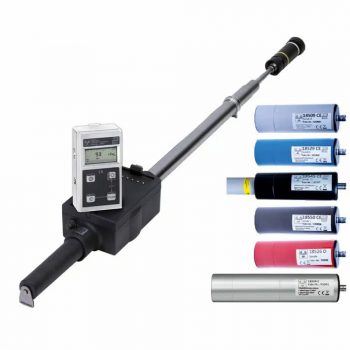
- For measuring high dose rates/pulse rates from a safe distance
- For measurements in poorly accessible measuring locations
- Easy connection with the X5C plus SE, X5C FW dose rate meters and the X5C plus calibratable dose rate meter via contact row using snap-in technology
- Safe connection of telescope and base unit without plug or cable (only via contact row)
- Telescope made of stainless steel, continuously extendable up to 4 m total length
- Torsion-proof connection between measuring head and electronics through internally routed ribbon cable
- Automatic measuring range switchover
- Display of dose rate at the operator’s location at the push of a button
- Voltage supply from the dose rate meter
- Energy range, measuring range, measured variable correspond to the data of the respective connected probes
- Possibility of connecting the X50ZS dose rate meter by means of a special adaptation module
 Datasheet Datasheet |
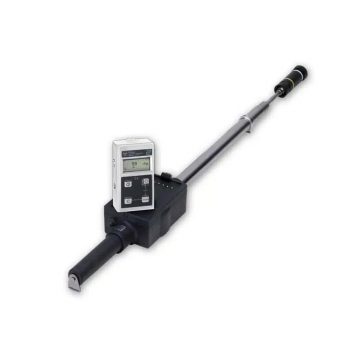
- For measuring high dose rate from a safe distance, dose rate measurement range up to 10 Sv/h for ambient dose equivalent rate Ḣ*(10).
- For measurements in poorly accessible measuring locations
- Safe connection of the telescopic probe DE with the dose rate meters X5C plus SE, X5C FW and the calibratable dose rate meter X5C plus without plug or cable by snap-in technology
- Stainless steel telescope, continuously extendable up to 4 m total length
- IP54 with telescope inserted and protective cap in place
- Torsion-proof connection between measuring head and electronics through internally routed ribbon cable
- Automatic measuring range switchover
- Display of dose rate at the operator’s location selectable at the push of a button
- Power supply from the X5C plus, X5C plus SE or X5C FW dose rate meter
- Possibility of connecting the X50ZS dose rate meter by means of a special adaptation module
| Datasheet |

Telescope Assemblies for Radiation Measurement Systems
In radiation measurement contexts, “telescopes” refer to devices or assemblies that allow flexible positioning of a detector — e.g. with extendable arms or probe holders. This enables measurements at a distance, precise positioning of probes or detection from a safe distance from hazardous or contaminated zones. Telescopes thus enhance safety and flexibility when measuring radiation in hard-to-access or high-risk areas.
Frequently Asked Questions about Radiation Telescopes
What is meant by a radiation telescope?
A radiation telescope is a mechanical device or extendable arm/probe holder that allows positioning of a detector or probe at variable distance from the main instrument. This permits investigation of a radiation source from a safe distance, without direct exposure of the operator.
When is the use of a telescope helpful?
A telescope is useful when measurements need to be taken in areas that are hard to access, contaminated or dangerous — for example inside pipes, tanks, shafts, or near highly radioactive objects. It is also beneficial when measurements should be conducted at a distance, such as in non-destructive testing or preliminary radiation field assessments.
Which detectors or probes can be combined with a telescope?
A telescope can be combined with various detector types — e.g. contamination probes, area detectors, Geiger-Müller tubes or scintillation detectors. The combination depends on the measurement task: surface contamination, dose rate measurement or radiation field analysis.
How does the length or extendability of a telescope affect the measurement?
With increasing telescope length, the distance between detector and radiation source increases — reducing the radiation intensity at the detector. This may require longer measurement times or more sensitive detectors to obtain reliable results. At the same time, the distance for the operator increases, enhancing safety.
What mechanical stability requirements exist for a radiation telescope?
A radiation telescope should be stable, torsion-resistant and made of robust material so that during measurement the detector geometry is not altered by movement or vibration. A solid stand, stable handle and minimal vibration are important for reproducible and safe measurements.
How should a telescope be properly positioned and handled?
The telescope should be handled so that detector or probe is stably and securely oriented toward the measurement location; abrupt movements or shaking should be avoided. For distant measurements a steady, controlled operation is needed to avoid scattering or misaligned detection.
How does distance affect detection limit and measurement time?
Distance reduces the radiation intensity reaching the detector roughly with the square of the distance (or according to the geometry). Therefore the detection limit may worsen and significantly longer measurement times may be needed. A careful calibration and, if necessary, an efficiency correction is required.
In which applications are radiation telescopes used?
Telescope assemblies are used for contamination checks in contaminated areas, measurements inside pipes, tanks or shafts, non-destructive testing, transport and packaging inspections of radioactive materials, or anywhere distance, safety and flexible probe positioning are required.
Which radiation protection requirements apply when using telescopes?
The telescope itself does not provide shielding, but by increasing the distance between operator and source it reduces exposure. Nevertheless, detector/probe must be properly shielded and calibrated; protective clothing and, if needed, supplementary shielding remain part of the radiation protection concept.
How should measurements using a telescope be evaluated and documented?
Measurement reports should include information on distance and geometry, because these influence count rate or dose rate. Documentation should list instrument type, sensor or probe ID, telescope length, positioning, measurement duration and result — to ensure traceability and reproducibility.
Which risks arise when using telescopes?
Risks include reduced detector sensitivity due to increased distance, uncertainties in measurement geometry, possible signal loss due to scattering or shielding, and mechanical instability. Therefore usage must be carefully planned, calibrated and documented to ensure reliable and safe measurements.
How is calibration handled when measurements are made with a telescope?
Calibration should ideally be performed using the final measurement geometry (distance, angle, probe configuration) or using a correction factor that compensates for efficiency loss due to distance and geometry. Without such calibration, measurement results may be systematically incorrect.