


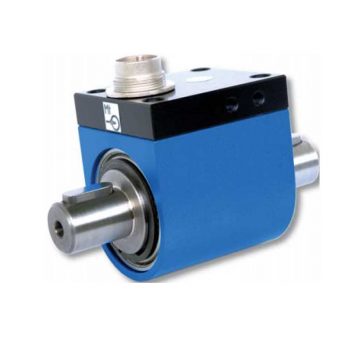
The HySense® TQ 110 is a highly accurate torque sensor, equipped with a with friction ring. It has a cylindric shaft with feather keys on both ends. It is available for several measurement ranges and is designed for continuous rotational speed of 1,500 to 2,000 rpm.

- Sensor principle Strain gauge, slip ring
- Measured variable Torque
- Measuring range 1 ... 500 Nm
- Output signal 12 ±8 mA ISDS
- Measuring accuracy 0.1% of full scale
- Electrical connector M16 x 0.75, 6-pin
- Ambient temperature -10 ... 60 °C
- IP degree of protection IP50 (DIN EN 60529)
 Datenblatt Datenblatt |

Torque Sensors – Accurate Measurement for Drives, Machines & Test Benches
Torque sensors measure the torsional force acting on a shaft, drivetrain or screw process and convert it into an electrical signal. They are essential for process monitoring, quality assurance, drive analysis, screw-driving technology, and industrial test benches.
Depending on the application, static or rotating torque sensors are used. Available designs range from compact torque shafts to flange-type sensors and integrated coupling systems. Measuring ranges span from milli-Newton metres (mNm) up to kilo-Newton metres (kNm), including modern output options like 4–20 mA, 0–10 V, frequency or CANbus.
FAQ About Torque Sensors
Answers regarding operating principles, applications, selection criteria and installation.
What is a torque sensor?
A torque sensor (torque transducer) measures the torsional load acting on a shaft or test body and outputs this mechanical quantity as an electrical signal.
How does a torque sensor work?
Most torque sensors use strain gauges (DMS) applied to a torsionally loaded measuring body. When the shaft twists under torque, the strain gauges change resistance, producing a measurable output signal.
What is the difference between static and rotating torque sensors?
Static torque sensors measure reaction torques without rotation. Rotating torque sensors measure torque while the shaft is spinning — often using contactless signal transmission.
Where are torque sensors used?
Typical applications include motor and gearbox test benches, e-mobility drive testing, screw-driving and assembly systems, robotics, conveyor systems, machine tools and quality control processes.
Which measuring ranges are available?
From mNm for precision mechanics up to kNm for heavy industrial use.
Which designs are available?
- Torque shafts
- Flange-type torque sensors
- Coupling or hub-integrated torque units
- Sensors with integrated bearings
Which output signals do torque sensors provide?
Typical outputs include mV/V, 4–20 mA, 0–10 V, frequency, PWM and digital interfaces such as CAN or CANopen.
How do I select the right torque sensor?
Key criteria include: torque range, maximum rotational speed (for rotating sensors), accuracy, available installation space, mechanical interfaces, environmental conditions and required signal output.
What must be considered during installation?
The sensor must be mounted stress-free and concentrically. Misalignment or mechanical tension can cause significant measurement errors. For high-speed applications, suitable couplings are essential.
What are common sources of error?
- Misalignment or mechanical stress during installation
- Overload or shock loading
- Vibration influences
- Incorrect coupling or shaft connection
Do torque sensors offer additional functions?
Many models include temperature compensation, speed output, bidirectional measurement (CW/CCW) or integrated signal conditioning electronics.
How can I request a quotation?
Please provide ICS Schneider Messtechnik with the required torque range, rotation speed, installation environment, mechanical interfaces and preferred output signal. A suitable offer will then be prepared.