






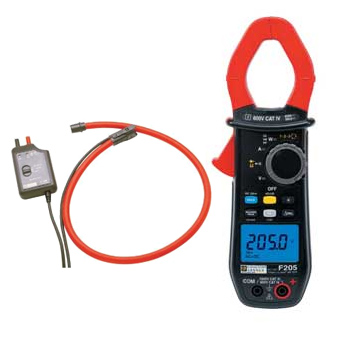
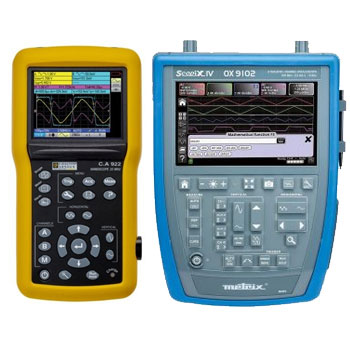


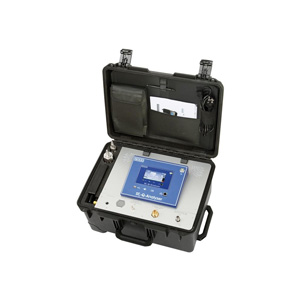
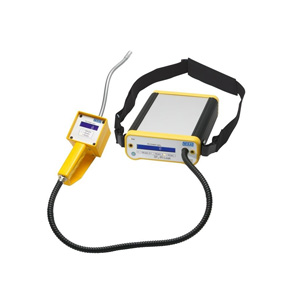
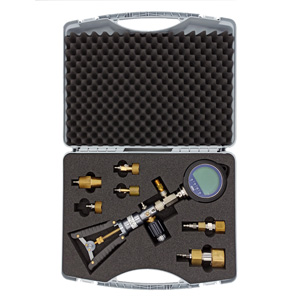

























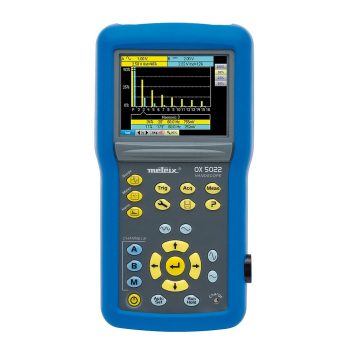
The HANDSCOPE combines 3 measuring instruments in 1 on 2 channels: - 20 MHz oscilloscope with 2 totally-isolated 600 V CAT III channels - 20 MHz bandwidth – 2 GS/s - 5 mV to 200 V/div and 25 ns to 200 s/div - Independent 8,000-count multimeter with power measurements, - Built-in 31-order harmonic analyser (fundamental between 40 and 450 Hz).
 Datasheet Datasheet |

The HANDSCOPE combines three measuring instruments in 1 on 2 channels: - 40 MHz oscilloscope with 2 totally-isolated 600 V CAT III channels – 40 MHz bandwidth – 2 GS/s - 5 mV to 200 V/div and 25 ns to 200 s/div - Independent 8,000-count multimeter with power measurements, - Built-in 31-order harmonic analyser (fundamental between 40 and 450 Hz)
| Datasheet |
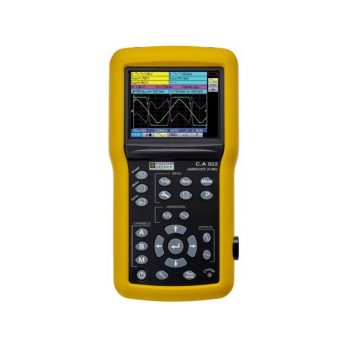
- Optimized 3.5” colour LCD screen for maximum visibility
- Multilingual interactive online help
- Data recording and recovery on PC
- Practical with its USB communication using the SCPI protocol
- Stand-alone, powered by NiMH rechargeable battery with USB charger
| Datasheet |
| User Manual |
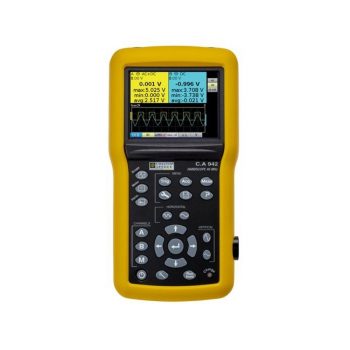
The HANDSCOPE combines three measuring instruments in 1 on 2 channels: - 40 MHz oscilloscope with 2 totally-isolated 600 V CAT III channels – 40 MHz bandwidth – 2 GS/s - 5 mV to 200 V/div and 25 ns to 200 s/div - Independent 8,000-count multimeter with power measurements, - Built-in 31-order harmonic analyser (fundamental between 40 and 450 Hz)
| Datasheet |
| User Manual |
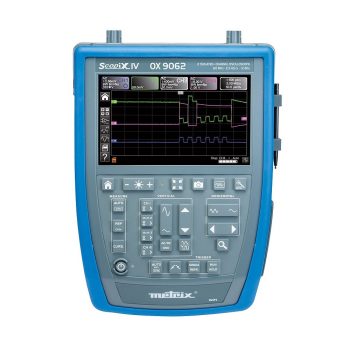
- 25 direct command keys on front panel Sampling rate: 2.5 GS/s in one-shot mode and max. 100 GS/s in ETS zoom mode Quick charging in 2 hrs; battery life up to 8 hrs Ethernet/Wifi/USB/µSD communication: the SCOPENET PC or tablet software can be used to take control of the instrument remotely and transfer curves or screenshots using your favourite browser. Large storage capacity: SD, SDHC, SDXC in addition to the 2 GB internal memory, µSD above 32 GB
- PROBIX plug-and-play accessories: quick implementation of the instrument with no risk of errors. The coefficients, scales and units of the sensors and the channel configuration are managed automatically and the probes and adapters are recognized as soon as they are connected. Delivered complete in a bag with its measurement accessories
| Datasheet |
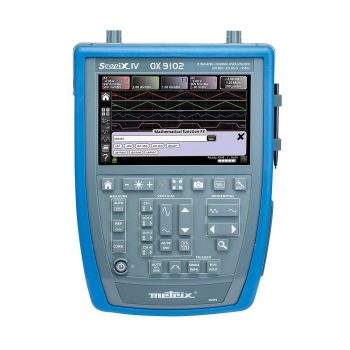
- 25 direct command keys on front panel Sampling rate: 2.5 GS/s in one-shot mode and max. 100 GS/s in ETS zoom mode Quick charging in 2 hrs; battery life up to 8 hrs Ethernet/Wifi/USB/µSD communication: the SCOPENET PC or tablet software can be used to take control of the instrument remotely and transfer curves or screenshots using your favourite browser. Large storage capacity: SD, SDHC, SDXC in addition to the 2 GB internal memory, µSD above 32 GB
- PROBIX plug-and-play accessories: quick implementation of the instrument with no risk of errors. The coefficients, scales and units of the sensors and the channel configuration are managed automatically and the probes and adapters are recognized as soon as they are connected. Delivered complete in a bag with its measurement accessories
| Datasheet |
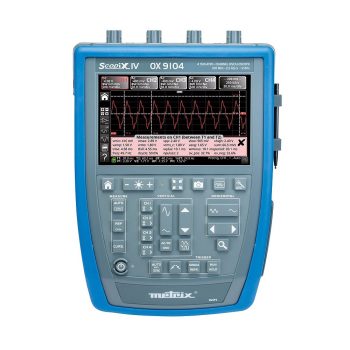
25 direct command keys on front panel Sampling rate: 2.5 GS/s in one-shot mode and max. 100 GS/s in ETS zoom mode Quick charging in 2 hrs; battery life up to 8 hrs Ethernet/Wifi/USB/µSD communication: the SCOPENET PC or tablet software can be used to take control of the instrument remotely and transfer curves or screenshots using your favourite browser. Large storage capacity: SD, SDHC, SDXC in addition to the 2 GB internal memory, µSD above 32 GB PROBIX plug-and-play accessories: quick implementation of the instrument with no risk of errors. The coefficients, scales and units of the sensors and the channel configuration are managed automatically and the probes and adapters are recognized as soon as they are connected. Delivered complete in a bag with its measurement accessories
| Datasheet |
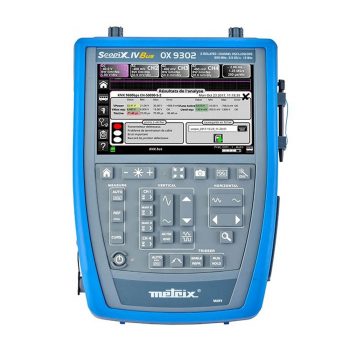
4 steps to qualify a data bus
- Verification of the transmission quality of signals using fieldbus protocols: KNX, DALI, CAN, LIN, FlexRay™, AS-i, Profibus®, RS-485, RS-232, ETHERNET, etc.
- Intuitive, upgradable Human-Machine Interface
- Multi-interface communication
| Datasheet |
25 direct command keys on front panel Sampling rate: 2.5 GS/s in one-shot mode and max. 100 GS/s in ETS zoom mode Quick charging in 2 hrs; battery life up to 8 hrs Ethernet/Wifi/USB/µSD communication: the SCOPENET PC or tablet software can be used to take control of the instrument remotely and transfer curves or screenshots using your favourite browser. Large storage capacity: SD, SDHC, SDXC in addition to the 2 GB internal memory, µSD above 32 GB PROBIX plug-and-play accessories: quick implementation of the instrument with no risk of errors. The coefficients, scales and units of the sensors and the channel configuration are managed automatically and the probes and adapters are recognized as soon as they are connected. Delivered complete in a bag with its measurement accessories
| Datasheet |
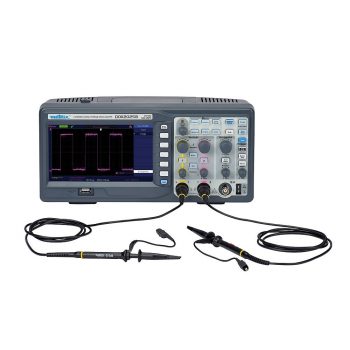
- 7-inch WGA colour display, resolution 800 X 480
- Fullmenus in 5 languages + on-screen contextual help in French/English
- 2-channelmeasurement capture + Ext Trig andcomplex triggers
- Vertical resolution: 8 bits
- 32 automatic measurements
- Cursors : Manual, tracking and automatic modes
- USB host and device communication
- IEC 61010-1 / 300 V CAT II
| Datasheet |
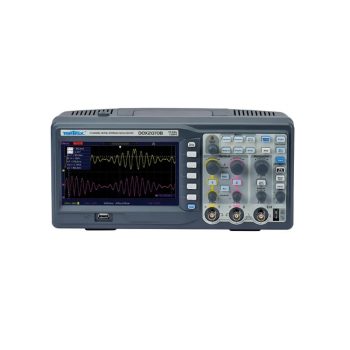
- Sampling rate of up to 1 GS/s in one-shot mode and up to 50 GS/s in ETS mode
- Vertical sensitivity from 2 mV/div. to 10 V/div. in 12 ranges
- 32 simultaneous automatic measurements on screen plus measurements by manual cursors
- Simple MATH functions +/-/*/÷ and “real-time” FFT function
- Configurable digital filters and waveform recording mode
| Datasheet |
| User Manual |
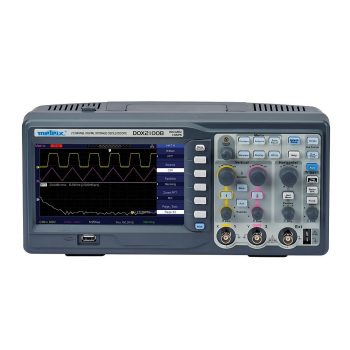
- 7-inch WVGA colour display
- Fullmenus in 5 languages + on-screen contextual help in English
- 2-channelmeasurement capture + Ext Trig andcomplex triggers
- 2 x100 MHz channels - Sweep speed from 2.5 ns/div. to 50 s/div.
- Sampling rate: one-shot= 500 MS/s (2 channels), 1 GS/s (one channel) / Repetitive = 50 GS/s
- Max. memory depth: 32 kpoints + unlimited storage capacity on USB key
- Vertical resolution: 8 bits (0.4%)
- 32 automatic measurements + cursors
- USB device and Ethernet RJ45 communication
- IEC 61010-1 / 300 V CAT II
| Datasheet |

The DOX3304 is a comprehensive digital oscilloscope equipped with a 25 MHz arbitrary function generator. It offers advanced digital technology to meet the needs of customers in a wide range of fields:
- designers and production and troubleshooting specialists in electronics, telecommunications, IT and peripherals
- automotive and industrial electronics
- automated systems
| Datasheet |
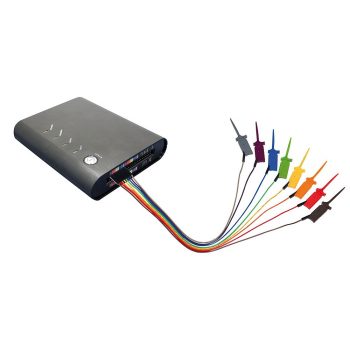
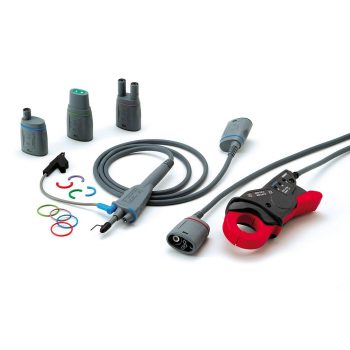
The PROBIX system ensures that SCOPIX oscilloscopes can be implemented quickly and, above all, without any risk of error, which is essential for instruments used for troubleshooting. For flawless compatibility, it is also possible to connect BNC connectors and standard leads using the safety adapters supplied. The sensors are powered and calibrated directly via the oscilloscope. Some of the accessories even have three control buttons directly accessible on the probe (e.g. HX0030 probe).
|
Datasheet
|

Oscilloscopes
Oscilloscopes are measuring instruments for time-dependent display of electrical voltages or signals. They plot voltage over time — ideal for analyzing signal waveforms, frequency, pulses, noise, PWM signals, transients or complex signal mixtures. Oscilloscopes are indispensable in electronics, development, troubleshooting, maintenance and test benches.
FAQ
What is an oscilloscope?
An oscilloscope is a device that displays electrical signals in the time domain, showing voltage as a function of time, so that waveform shape, frequency, amplitude and other signal characteristics can be analyzed.
Which signals can be displayed with an oscilloscope?
Common signals include AC voltage, DC voltage, digital signals, PWM signals, pulses, sine and square waves, transients, noise, disturbances and complex mixed-frequency signals.
Why are oscilloscopes important?
They allow detailed analysis of waveform shape, distortions, noise, frequency components, switching events, phase shifts, transients and behavior of circuits under dynamic conditions — essential for development and fault diagnosis.
What do trigger and sweep/time base mean on an oscilloscope?
The trigger stabilizes the waveform display by defining a start condition; the sweep or time base sets how much time is displayed per division, determining how long the signal trace lasts.
What does bandwidth mean and why is it important?
Bandwidth defines the maximum signal frequency the oscilloscope can accurately display. Insufficient bandwidth will distort fast signals or high-frequency components.
What is the sample rate?
The sample rate determines how many samples per second the instrument takes. Higher sample rates deliver more accurate representation of fast or transient signals and avoid aliasing.
How many channels and input types are typical?
Many oscilloscopes offer two or more channels; some have differential inputs, compatibility with current probes or separate inputs for different voltage ranges. Input coupling (DC/AC) and impedance are important.
What is DC vs. AC coupling?
DC coupling shows both DC and AC components of a signal; AC coupling blocks the DC component so only AC variation is displayed — useful for small signal analysis or noise detection.
How do you set trigger and measurement functions?
Trigger type (edge, pulse, video, etc.), trigger level and edge define when sampling starts. Measurements can include cursors, peak/peak-to-peak, min/max, mean, FFT (frequency analysis) and automatic parameter detection.
What is FFT analysis and when is it useful?
FFT (Fast Fourier Transform) converts the time-domain waveform into its frequency components — useful for analyzing harmonics, noise, signal distortion, modulation or interference.
Why does memory depth matter?
Memory depth determines how many samples can be stored — crucial for long signal captures or high-resolution sampling of fast signals for detailed analysis.
What are typical application areas?
Electronics development, embedded systems, power electronics, motor control, automation, maintenance, signal diagnostics, PWM-control, power supply testing, training, repair and laboratory work.
Which safety precautions apply when using an oscilloscope?
Ensure signals are within safe voltage range, use appropriate probes and grounding, verify isolation and protective measures — especially when measuring high voltages or non-isolated circuits.
How to choose an oscilloscope?
Key selection criteria: bandwidth, sample rate, number of channels, memory depth, trigger functionality, input impedance, power supply (portable vs stationary), display quality, probe compatibility and optional features (FFT, measurement automation).
What are common measurement errors?
Errors can result from improper grounding or probe connection, incorrect bandwidth or sampling rate, aliasing, insufficient probe rating, interference, incorrect trigger settings or overloaded inputs.
How to maintain and calibrate an oscilloscope?
Regular inspection of probes and connectors, cleanliness, input check, adjustment if required; for professional or safety-critical use periodic calibration is recommended to ensure measurement accuracy.
Can an oscilloscope measure current?
Yes — using suitable current probes or clamp-on current sensors, provided probe bandwidth and coupling are appropriate and correct grounding and isolation are maintained.